




Community Support & Resources
Below is a list of Resources, Articles and Information to help users navigate their recovery. As we become aware of additional critical information and resources, we will continue to update this page.
We encourage anyone who is aware of additional resources, support or detailed instructions to contact us with details at tribe@studiokulamedia.com. Please provide credit information for any original article.
Note: Studio Kula & Community, Serve Us are not affiliated with, do not endorse and make no guarantee of the services provided through any of the listed resources.
General Help: Useful Links & Contacts
Survivor & Grassroots Community Groups
Photo by Vonecia Carswell on Unsplash
Eaton Fire Survivors Network (EFSN) is a fiscally sponsored project of Habitat for Humanity of Greater Los Angeles and is guided by “Three Pillars of Recovery:”
Connecting Survivors to One Another, and to Vital Resources
Growing Survivor Voice and Leadership
Building the Civic Coalitions to Secure the Billions Needed for Recovery
Visit to find educational articles and webinars, access to the Coalition for Urgent Housing Relief, Coalition for a New Insurance Commissioner, survivor stories, upcoming events, and pathways to get provide support.
“Steadfast LA is a civic nonprofit organization dedicated to accelerating the rebuilding Los Angeles after the devastating wildfires by bringing together top leaders, bold ideas, and effective solutions to get things done right and fast.”
Eaton Fire Collaborative’s “mission is to provide a coordinated response and clear communication to ensure that resources, assistance, and information reach the people and organizations that need them most.”
They help by providing:
Trusted Resource Hub
Master Calendar + Donation Distribution & Events
Establish a Long-Term Recovery Plan
Efficient Coordination
Eaton Fire Volunteer Hub
Financial Compensation, Aid & Grants
Photo by Alexander Schimmeck on Unsplash
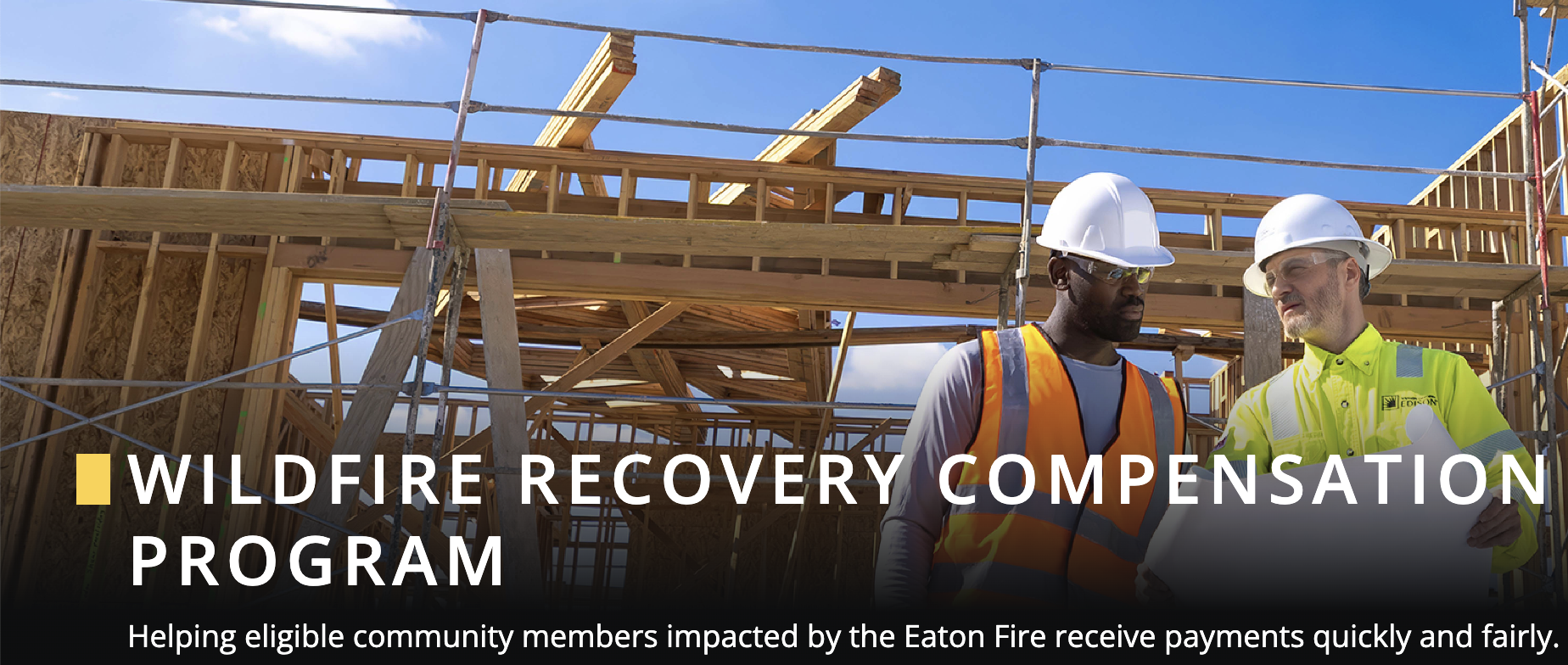
Wildfire Recovery Compensation Program for eligible Eaton Fire owners & tenants is available through Southern California Edison (SCE). Claims can be submitted via attorney for “total and partial structure loss, commercial property loss, business interruption, non-burn damage (such as smoke, soot or ash), physical injury and loss of life.” See the full article below for more information.
Mortgage Relief through CalAssist Mortgage Fund provides 3 months of mortgage payments up to a total of $20,000 for those whose primary residence was destroyed or uninhabitable due to a qualified disaster between Jan 1, 2023 and Jan 8, 2025. Funds never have to be repaid and assistance is available for those who need help filing.
Music Industry Professionals can apply for assistance with vital living expenses , medical bills or damaged musical equipment through Sweet Relief Musicians Fund. Besides the disaster relief fund, they have a variety of designated funds for career musicians or industry professionals unable to make ends meet to to physical or mental health issues, disability or age-related problems.
Mental & Emotional Support
Photo by National Cancer Institute on Unsplash
LA County Department of Mental Health offers in-person mental health services (including counseling, medication assistance, crisis stabilization, and linkage) 9 AM-5 PM, Mon – Fri. 24/7 support is available through the Help Line at (800) 854-7771 and the 988 Suicide & Crisis Lifeline.
Substance Abuse & Mental Health Services Administration’s (SAMHSA) Disaster Distress Helpline offers free, 24/7, confidential, multilingual crisis support by phone or text at 1–800–985–5990
Legal Assistance
Photo by Gabrielle Henderson on Unsplash
FEMA through the Young Lawyers Division of the American Bar Association provides Disaster Legal Services to provide confidential help with:
- Insurance claims for medical bills, loss of property, loss of life, etc.
- New wills and other legal papers lost in the disaster.
- Home repair contracts and contractor fraud.
- Problems with landlords.
- Proof of home ownership.
- FEMA appeals.
The County of Los Angeles Department of Economic Opportunity (DEO), the City of Los Angeles Economic and Workforce Development Department (EWDD), Bet Tzedek Legal Services, and Public Counsel have teamed up to form the LA Regional Small Business Owners Legal Aid Program to provide assistance and relief for small & micro-business services from underserved communities offering guidance on relief programs, insurance claims, or rebuilding assistance.
Legal Aide Foundation of Los Angeles (LAFLA) provides support for disaster victims, including those of the LA Wildfire, such as FEMA applications and appeals, tenant and homeowner issues, and consumer relief.
Articles
When the System Fails: How Communities Become the First Line of Defense in Disasters
March 26, 2026
Recent Disasters Have Shown Community Infrastructure is the Real First Line of Defense
Photo by Amon Hale Jr. on Unsplash
When disaster strikes, we instinctively turn to official systems — emergency alerts, coordinated response teams, and government support. There is a deep, almost invisible trust when something goes wrong at scale, a belief that there is a structure designed to protect us.
The 2025 Los Angeles wildfires showed us a harder truth: even well-resourced systems can lag behind fast-moving realities.
And when they do, something more powerful steps in: people and communities
Read More/Less
When Systems Are Under Pressure, Minutes Decide Outcomes
The 2025 Los Angeles wildfires were not just an environmental event, they were a stress test.
Fires raced through Altadena, Pacific Palisades, and other areas, forcing tens of thousands to evacuate — at the peak of the crisis, nearly 180,000 people across Southern California were under evacuation orders Roads filled with traffic, communication networks became overloaded, and uncertainty spread just as fast as the flames.
Many residents received evacuation alerts after flames had already reached nearby streets. Communication networks overloaded. Roads jammed. In critical moments, the official system relied on for guidance was no longer leading the response. It was lagging behind reality.
In fast-moving disasters like wildfires, timing is everything. A delay of minutes can change evacuation routes, access to safety, and ultimately, survival. Disaster response systems, while complex and resource-rich, are not always designed for the speed of reality. They operate at scale., but disasters unfold street by street.
People Didn’t Wait.
The gap between system response and real-time danger became painfully visible.
So, people didn’t wait. They made decisions based on what they saw — smoke in the distance, changing winds, the urgency in a neighbor’s voice.
Neighbors knocked on doors to warn others. Strangers offered rides to those without transportation. Families who rarely spoke suddenly became each other’s lifeline. Safety came from proximity, quick thinking, and simple human connection — not just from coordination centers.
The Wisdom That We Already Existed
Long before modern fire management systems existed, Indigenous communities in California had developed ways to fight fire with fire.
Tribes such as the Karuk, Yurok, Hoopa Valley, Miwok, and Mono have practiced cultural burning for generations. These intentional, low-intensity fires reduced dangerous fuel buildup, restored ecosystems, protected communities, and strengthened the relationship between beings and the land.
For generations, this tradition was suppressed and outlawed. Today they are being revived as one of the most effective tools for preventing catastrophic wildfires. The power behind this tradition is the mindset of the people who practice it — fire is only a threat when it’s not respected and used properly as a tool.
Communities as Both Responders and Stewards
When systems fail, communities do more than respond — they prevent.
Indigenous fire stewardship is a powerful example of this shift — from reactive systems to proactive care. It shows that resilience is not built only in moments of crisis. This is a fundamentally different model from traditional disaster response. It is not about reacting faster. It is about reducing the need to react at all.
As climate-driven disasters become more frequent, real resilience isn’t only about better alerts or bigger budgets. It’s about relationships that are already in place when the smoke appears.
The real first line of defense isn’t something that arrives after the disaster. It reveals itself through the people who are already there — caring for the land, for each other, and for solutions that work at the street level.
Why Community Is Essential Infrastructure
What happens after the immediate danger passes is less visible — but just as important. Survivors enter a new phase of uncertainty. They need housing, financial aid, guidance navigating insurance, mental health support, and more. But navigating fragmented systems and overlapping agencies is exhausting and overwhelming.
Communities are proving to be the fastest responders, the most adaptive networks, and often the most immediate source of help.
These experiences highlight a growing reality: institutions remain important, but they are no longer sufficient on their own.
The strongest recovery doesn’t come from purely top-down systems. It comes from hybrid approaches — combining official resources with community speed, local knowledge, and relationships built before the crisis hits.
Neighborhoods that recover faster are usually the ones where people already know their neighbors, communication flows quickly, and informal support systems exist.
The Real First Line of Defense
- people know each other
- communication flows quickly
- informal support systems already exist
Ready to turn insight into action?
If you’ve experienced the gap between official systems and real community response — or if this article has sparked ideas for faster alerts, better neighbor networks, cultural burning initiatives, recovery navigation tools, or any other practical solutions — we want to hear them.
Share your experience or submit your idea directly to our Idea Boards right now.
Your voice could help shape the next wave of community-driven solutions for LA wildfire recovery and future disaster prevention.
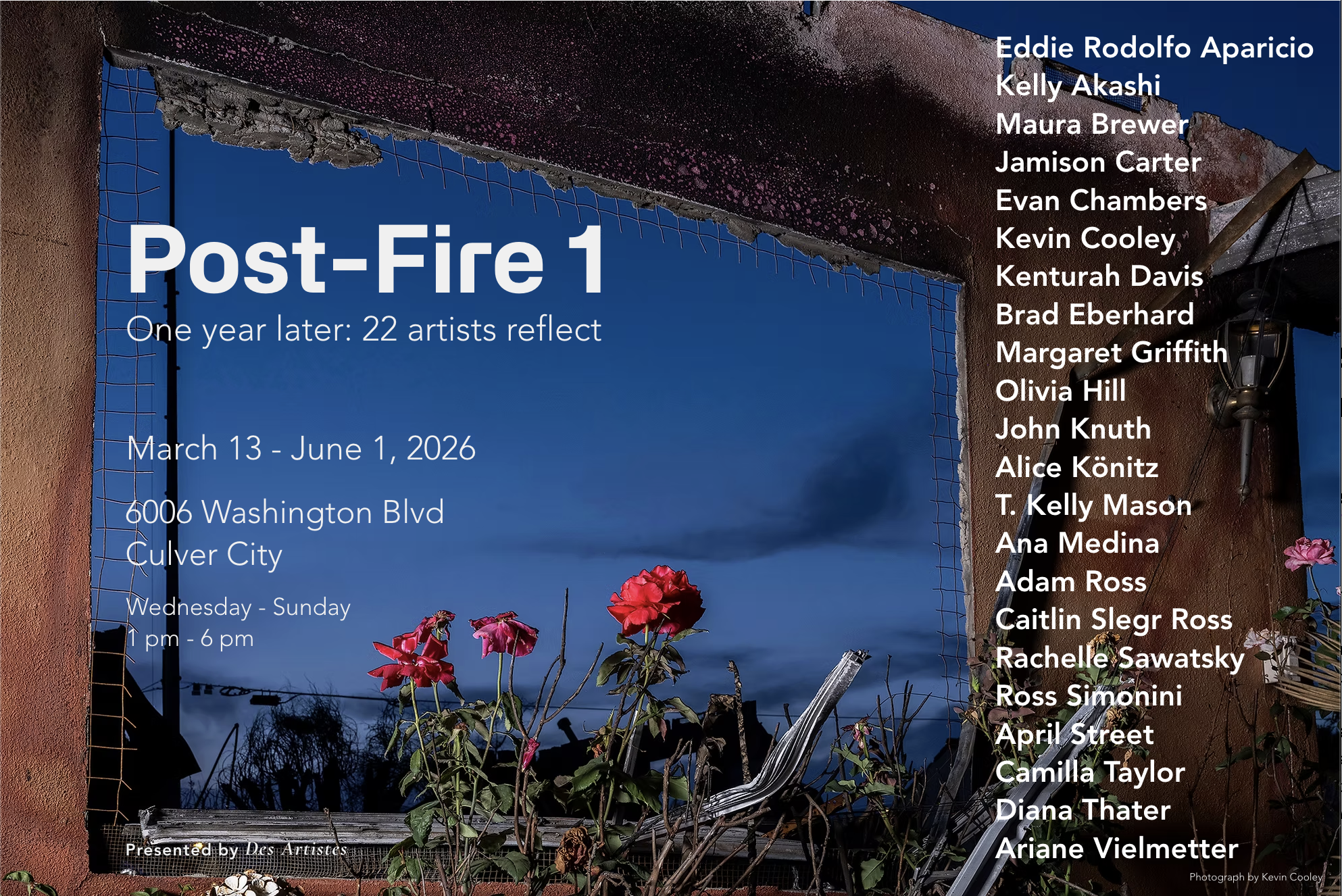
Des Artistes in Culver City Showcases 22 Artists Who Lost Their Homes & Studios in the Eaton Fire
March 17, 2026
Post-Fire 1 Will Benefit the Artists Devastated by Loss from the January 2025 Fire
According to https://www.des-artistes.com:
“Post-Fire 1 is the first installment of an annual group show, planned for the next 4 years at 6006 Washington Blvd in Culver City. The intent of the Post-Fire series is to showcase and support artists who have experienced the traumatic loss of homes and studios. As a testament to their unbreakable spirit, impacted artists have continued to produce works despite enormous obstacles—taking care of family while grieving, determining how to proceed, replacing equipment and finding a place to create and live, mountains of insurance paperwork, and in some instances, decades of artwork rendered to ash. Post-Fire 1 highlights recent works created by 22 artists from the Altadena area. These works have been made primarily after the devastation of the Eaton fires. Our unifying theme was that artists show what they would like to show—in sculpture, painting, photography and video. All proceeds from sales will go to the artists, with Des Artistes taking no sales commission. “
Read More/Less
“Post-Fire 1 launches March 13, 2026 and runs for 10 weeks. It will be open weekly from Wednesday through Sunday, 1 – 6 PM. We will host an artist panel, music event and print release during the run of the exhibit.
Post-Fire 1 extends the efforts of the Los Angeles art community, which came together in the wake of the 2025 fires. Much of the work in this show is thanks to generous financial aid, studio spaces, and previous group shows that were created in response to the crisis. The Post-Fire exhibitions look to continue this support into the future, fostering consistent opportunities for affected artists to have a space to showcase the development of their practices.
About Des Artistes
Des Artistes is a newly-formed private arts organization that is open to the public. It will showcase new and established artists, offer music and community events at 6006 Washington Blvd in Culver City. “
Eaton Fire 2025: Wrongful-Death Lawsuits Against SCE, AG Rob Bonta Civil Rights Investigation, Altadena Evacuation Delays
March 15, 2026
Photo Credit: Photo by LOGAN WEAVER | @LGNWVR on Unsplash
Accountability and Equity Amidst Lawsuits and Investigations
The Eaton Fire in January 2025 devastated Altadena and nearby Los Angeles communities, claiming 19 lives—most in the historically Black neighborhood of West Altadena—while destroying thousands of homes and structures. One year on, accountability efforts are intensifying through wrongful-death lawsuits, a civil rights investigation into potential discrimination, and emerging whistleblower concerns. These overlapping developments highlight failures in utility safety, emergency equity, and government response—raising critical questions for residents and policymakers alike.
Read More/Less
1. Wrongful-Death Lawsuits Target Southern California Edison
Families of victims have filed numerous wrongful-death and negligence lawsuits, primarily against Southern California Edison (SCE). Investigations point to SCE’s power lines and failure to de-energize them during high Santa Ana winds as the likely ignition source.
Key cases include:
- A lawsuit by civil rights attorney Ben Crump on behalf of the family of 83-year-old Erliene Kelley, alleging SCE’s negligence in infrastructure maintenance and ignoring weather warnings.
- Filings by firms like Corey Gibbs Fire Lawyers, Cotchett Pitre & McCarthy, Singleton Schreiber, and others representing survivors, families, and communities seeking compensation for lost lives, destroyed homes, and trauma.
SCE faces hundreds of lawsuits from victims, insurers, governments (including the U.S. Department of Justice for National Forest damage), and others. The utility has launched a compensation program but denies full responsibility, while cross-claiming against LA County and agencies.
2. Civil Rights Investigation Probes Delays in West Altadena Evacuations
California Attorney General Rob Bonta launched a formal investigation in February 2026 into whether race, age, or disability discrimination affected the Eaton Fire emergency response in West Altadena.
Central issues:
- Evacuation warnings for the historically Black West Altadena arrived hours later (up to 8 hours in some reports) than in nearby, often whiter and wealthier areas east of Lake Avenue.
- 18 of the 19 fatalities occurred in West Altadena, with victims averaging 77 years old.
- The probe examines emergency notification systems, evacuation planning, and operational decisions for disparate impacts.
Civil rights attorneys including Ben Crump and Carl Douglas are supporting families, filing public-records requests, and considering federal action if discrimination is confirmed.
3. Whistleblower Allegations and Calls for Transparency
Recent reporting reveals additional concerns:
- A whistleblower complaint from LA County Office of Emergency Management associate director Nick Vaquero alleges a former colleague—known for a “history of sleeping on the job”—supervised key alert functions during the fire’s critical early hours.
- Public-records requests and demands for independent after-action reviews seek full details on alert decisions, staffing, and response protocols.
These connect to the Attorney General’s probe, civil lawsuits, and broader pushes for reform in emergency systems.
Tying It Together: Equity, Accountability, and Prevention
The Eaton Fire exposed deep cracks: utility negligence sparking preventable blazes, delayed alerts disproportionately harming vulnerable communities, and staffing issues undermining public safety. As lawsuits proceed, investigations unfold, and whistleblowers speak, Los Angeles must address these systemic failures to protect all residents.
What do you think—share your perspective in our forum:
- Should utilities like SCE face harsher penalties and stricter regulations for equipment failures that ignite wildfires? What reforms would you prioritize?
- Do the evacuation delays in West Altadena indicate systemic discrimination, operational oversights, or both? What evidence or changes would restore trust in emergency alerts?
- How should LA County and the state respond to whistleblower claims and calls for transparency—through independent audits, better staffing protocols, or new alert technology? What one improvement would most protect your community?
Join the moderated discussion: “Eaton Fire Accountability: Wrongful-Death Lawsuits, Civil Rights Probe, and Equity in LA Wildfire Response.” Your input drives better preparedness and justice.
**Sources & External Links :
- Attorney General Rob Bonta’s announcement of the investigation: California Department of Justice Press Release (Feb 12, 2026).
- Ben Crump’s lawsuit filing for Erliene Kelley’s family: Ben Crump Law Press Release.
- Whistleblower complaint details: LAist Report (March 2026).
- Additional lawsuit coverage (SCE cases): Corey Gibbs Fire Lawyers; Cotchett, Pitre & McCarthy; Singleton Schreiber.
- Broader context on fatalities and response delays: Los Angeles Times; ABC7.
Readers are encouraged to review the original reporting for full context.
LA Wildfire Recovery and the 2026 Elections: What Do You Expect From the Leaders Asking for Your Vote?
March 3, 2026
Trust, Transparency, and Wildfire Readiness: The 2026 Leadership Test Facing Los Angeles
As Los Angeles moves closer to the June 2, 2026, mayoral election and the November 3, 2026, gubernatorial election, the political conversation is increasingly intersecting with emergency governance.
Recent developments tied to the Palisades Fire – including newly released depositions, internal Los Angeles Fire Department (LAFD) communications reported by major outlets, public statements from Mayor Karen Bass, and a lawsuit filed by former Fire Chief Kristin Crowley – have intensified public discussion about wildfire preparedness, emergency response transparency, and leadership accountability in Los Angeles.
While legal proceedings and investigative reporting continue, a broader civic question is emerging:
What do you expect from the candidates who will earn your vote in 2026?
Read More/Less
Key Takeaways
- Newly released depositions connected to the January 2026 Lachman Fire described testimony about post-fire monitoring concerns and the circumstances that preceded the Palisades Fire.
- Media reporting on internal LAFD communications raised questions about transparency and the handling of the department’s After-Action Report.
- A lawsuit filed by former Fire Chief Kristin Crowley has further intensified public discussion about leadership accountability and departmental independence.
- Wildfire readiness in Los Angeles involves shared responsibility across city, county, and state leadership, making coordination and governance structures central issues.
- As the June 2, 2026, mayoral and November 3, 2026, gubernatorial elections approach, voters may consider not only policy proposals but also how emergency systems are managed in practice.
- We have opened a forum thread: “LA Wildfire Recovery & 2026 Elections: What Do You Expect From Your Leaders?”
What Happened – and Why the Debate Reopened
In recent weeks, depositions related to the Palisades Fire were made public. Testimony connected to the January 2026 Lachman Fire described concerns about monitoring after the initial brush fire was believed to be contained. According to deposition testimony, firefighters reported finding smoldering, red-hot coals and raised concerns about potential flare-ups. They were reportedly told that California State Parks would monitor the area. However, a state employee allegedly did not return to check for flare-ups, and the fire later reignited, contributing to widespread destruction.
Separately, media reporting described a confidential LAFD memo outlining a communications strategy intended to limit reputational harm to Mayor Karen Bass, members of the Mayor’s office, and LAFD leadership in connection with the department’s After-Action Report. Reports also referenced coordination with an outside public relations firm.
Mayor Bass has denied directing any changes to the report, stating publicly that the fire department handles operational reviews independently and that her office did not interfere with findings.
Adding to the scrutiny, former LAFD Fire Chief Kristin Crowley has filed a lawsuit alleging retaliation stemming from internal disagreements and public testimony on departmental resourcing and wildfire preparedness.
Individually, each of these developments raises serious questions about process and oversight. Taken together, they have intensified public demand for clarity – not only about what happened, but about how decisions were made and who is ultimately accountable when emergency systems fail.
Why Wildfire Governance Is a Structural Issue in Los Angeles
Wildfire governance is not an abstract policy debate in Southern California. It is a recurring operational reality.
Los Angeles faces:
- Increasing wildfire frequency
- Extended dry seasons
- Expansion of the urban-wildland interface
- Growing strain on emergency response systems
- Stronger, more frequent Santa Ana wind events, with 2025 seeing gusts up to 80 mph.
In this context, emergency response transparency and measurable preparedness standards become foundational to public trust.
These are structural conditions – meaning they are built into our environment and climate realities. That makes leadership structure – not just emergency response – central to public trust.
Los Angeles wildfire preparedness operates within a layered governance system:
- City leadership (Mayor and City Council)
- LAFD operational command
- County emergency coordination
- State-level wildfire response agencies
Effective preparedness depends on coordination across these levels. But accountability often gets simplified to one office – usually the Mayor – even when responsibility is shared.
Governance vs. Policy (In Plain English)
Policy is what candidates promise. Governance is how the system actually works.
For example, a candidate may promise “stronger wildfire prevention.” But governance asks:
- Who controls funding?
- Who issues rebuilding permits?
- Who regulates insurance markets?
- Who oversees independent After-Action Reports?
In a crisis, governance determines whether promises translate into action.
Layered Accountability: Who Is Responsible?
State – Led by the Governor
Role: Sets rules, controls major funding, coordinates statewide emergency systems.
Responsible for:
- Declaring emergencies
- Mobilizing CAL FIRE and the National Guard
- Funding recovery
- Insurance regulation
- Long-term wildfire prevention strategy
Common challenges may include:
- Insurance instability
- Slow policy implementation
- Insufficient prevention investment
The Governor holds significant authority over emergency powers and insurance regulation – areas that directly affect wildfire recovery.
City – Led by the Mayor
Role: Frontline execution where residents feel the impact.
Responsible for:
- Issuing rebuilding permits
- Local evacuation planning
- Fire department response
- Enforcing building codes
- Zoning and land use
Common challenges may include:
- Permitting delays
- Bureaucratic red tape
- Evacuation communication gaps
Even if the State pushes urgency, cities control permits – one of the biggest real-world recovery pain points.
County – Led by Supervisors
Role: Regional coordination and safety net services.
Responsible for:
- Public health services
- Shelter and mental health response
- Aid distribution
- Debris removal in unincorporated areas
Common challenges may include:
- Gaps in services for vulnerable populations
- Slow aid distribution
- Coordination breakdowns
In areas like Altadena (unincorporated), the County plays an even larger role.
Where Systems Break
- The Hand-Off Problem: State provides funding. City controls rebuilding. The county manages services. When coordination falters, delays and finger-pointing follow.
- Permitting Gridlock: Cities control rebuilding pace.
- Insurance Crisis: The State regulates insurance markets.
- Vulnerable Populations Falling Through: When the city, county, and state don’t align, residents can be missed.
How This Could Shape Voter Opinion in 2026
The impact of this debate may hinge less on legal outcomes and more on trust.
Voters may evaluate candidates on:
- Transparency during crises
- Independence of After-Action reporting
- Crisis communication standards
- Preparedness metrics
- Ability to coordinate across government levels
Over time, this may evolve from a legal story into a broader leadership narrative.
Six Simple Questions for 2026 Candidates
To make this accessible for everyday voters, we are asking:
- If something goes wrong, who takes responsibility?
- Will you guarantee an independent After-Action review?
- How fast should rebuilding permits be issued?
- What wildfire preparedness metrics will you publish every year?
- What information will you commit to sharing during an emergency?
- How will you prevent finger-pointing between the city, county, and state?
These are questions residents can answer – and candidates should too.
Join the Discussion
We’ve opened a moderated forum thread:
“LA Wildfire Recovery & 2026 Elections: What Do You Expect From Your Leaders?”
The six questions above are intended not only for candidates, but for our community.
We invite you to share your perspective, respond to the questions, and discuss what leadership, transparency, and accountability should look like in Los Angeles moving into the June 2 and November 3, 2026 elections.
Join the discussion here: https://communityserve.us/adult-community/forums/discussion/la-wildfire-recovery-the-2026-elections-what-do-you-expect-from-your-leaders/
Looking Ahead
In a city where wildfire risk is structural rather than episodic, emergency preparedness is inseparable from leadership.
As 2026 approaches, voters may not only ask who should lead, but how the system should function when the next fire comes.
**Sources & Reporting
The developments summarized above are based on reporting from the following outlets:
Deposition & Lachman Fire Testimony
- Daily News: “LAFD firefighter testifies he warned that Lachman Fire was not fully out when crews were told to pack up” (Feb 27, 2026) https://www.dailynews.com/2026/02/27/lafd-firefighter-testifies-he-warned-that-lachman-fire-was-not-fully-out-when-crews-were-told-to-pack-up/
- FOX 11 Los Angeles: Coverage of released Palisades Fire depositions https://www.foxla.com/video/fmc-5v8jf7bpelgxa37f
After-Action Report Allegations & LAFD Memo
- Los Angeles Times: “Confidential memo reveals how LAFD tried shielding Mayor Bass from fire fallout” (Feb 20, 2026) https://www.latimes.com/california/story/2026-02-20/lafd-tried-to-protect-bass-from-reputational-harm-stemming-from-after-action-report
- FOX 11 Los Angeles: “Confidential memo shows LAFD tried to protect Bass from Palisades fire criticism” https://www.foxla.com/news/lafd-confidential-memo-protect-bass-palisades
- KTLA 5: Coverage of allegations related to the Palisades Fire After-Action Report https://ktla.com/news/local-news/l-a-mayor-bass-denies-report-she-directed-altering-of-palisades-fire-review/
- FOX 11 Los Angeles: “Bass allegedly influenced Palisades fire report” https://www.foxla.com/news/lafd-confidential-memo-protect-bass-palisades
Former Fire Chief Lawsuit
- FireRescue1: “Former LAFD fire chief sues Mayor Karen Bass over alleged retaliation after Palisades Fire” (Feb 25, 2026) https://www.firerescue1.com/legal/former-lafd-fire-chief-sues-mayor-karen-bass-over-alleged-retaliation-after-palisades-fire
Readers are encouraged to review the original reporting for full context.
When Systems Fail, “Survivor Voices become Civic Leadership”
February 12, 2026
Photo by Jen Gunter on Unsplash
A Sudden National News Moment Creates an Opportunity for Survivor-Led Learning
Joy Chen, Executive Director of Eaton Fire Survivors Network, recently shared how a sudden national news moment triggered by the Trump executive order announcing the federal takeover of the local permitting process for survivors of the LA Wildfires created a narrow window to shape public understanding of wildfire recovery in Los Angeles. Media requests surged. Deadlines were tight. Survivors were needed on camera within hours.
What followed was not improvisation; it was coordination.
Read More/Less
Survivors, advocates, local officials, and recovery organizations quickly aligned around a shared message: the primary barrier to recovery was not permitting, but it was delayed and insufficient funding. “[W]e need President Trump to release the federal disaster relief we’re due.” Through rapid communication and trusted networks, survivor voices reached national outlets, reframing the narrative and calling for urgent federal disaster relief.
This moment reflects a broader truth: recovery does not move forward automatically. It moves when people connect, align, and speak together.
Joy’s full reflection can be read here:
👉 From a Trump Executive Order, to National Coverage That Changes Outcomes
Her account offers more than a personal story. It is a clear case study of how recovery actually moves when traditional systems fail – through survivor coordination, shared storytelling, and collective action.
Lessons for Communities Facing Future Disasters
The experience of LA wildfire survivors offers important lessons for communities across the United States facing wildfires, floods, storms, and other climate-driven disasters:
- Recovery does not end when headlines fade
- Isolation benefits broken systems; connection challenges them
- Coordinated survivor voices shape public understanding and policy response
- Platforms for shared experience are essential to long-term resilience
Disasters may be local. Recovery challenges are widely shared.
The Data Behind the Story: A National Pattern
What happened in Los Angeles reflects a broader national trend of escalating climate and weather impacts.
According to Climate Central’s “2025 in Review”, the United States experienced a growing number of extreme weather events, underscoring the rising costs and complexity of disaster recovery nationwide.
Source: https://www.climatecentral.org/climate-matters/2025-in-review
At the same time, data from FEMA show a steady increase in federally declared disasters over the past decade, placing mounting pressure on local and federal recovery systems.
Source: https://www.fema.gov/openfema-data-page/disaster-declarations
Storytelling as a Tool for Accountability
Joy’s reflection also illustrates how survivor storytelling evolved – from isolated complaints to collective accountability.
Investigative reporting by The Guardian, in “Delays, lowballs, outright denials’: how the LA wildfires exposed the US’s broken insurance industry” documents how the LA wildfires exposed systemic failures in the U.S. homeowners’ insurance industry, including delayed claims, lowball offers, and outright denials that left survivors financially stranded.
And, in their article, “California insurance plan asks private insurers for $1bn after wildfires.,” They report that California’s FAIR Plan – the insurer of last resort – has requested $1 billion from private insurers to cover wildfire claims, highlighting the financial strain on the recovery system.
According to EFSN, survivor coordination helped unlock more than $100 million in insurance payouts, directly depositing the funds into survivor accounts during the first year of recovery.
In this context, storytelling was not simply about being heard. It became a mechanism for identifying patterns, driving accountability, and moving resources.
Recovery Is Not Only Infrastructure – It Is Mental Health
Public health data confirms what survivors describe every day.
The Centers for Disease Control and Prevention (CDC) reports that disasters are strongly associated with increased anxiety, depression, and trauma-related stress, particularly when recovery is prolonged.
Research from the Urban Institute shows that disasters can trigger long-term housing and financial instability, including displacement, rising housing costs, and increased eviction risk – which compounds stress and worsens long-term health outcomes for affected households.
These findings reinforce a critical reality: stable housing, timely compensation, and financial security are mental health interventions. When recovery systems break down, survivors often internalize failure. As Joy reminds us, this is not individual resilience failing – it is systems failing people.
Recovery Is a Collective Process
The experience of LA wildfire survivors reminds us that recovery is not a linear process, nor is it solely an individual one. It is shaped by systems, policies, access to information, and, critically, by whether people can connect, share knowledge, and act together.
Survivor-led coordination and communication do more than raise awareness. They surface patterns, expose gaps, and help communities move from isolation toward collective solutions.
As climate-driven disasters continue to affect communities across the country, these lessons matter – not just for Los Angeles, but for anyone navigating recovery after loss.
If you are looking for ways to support survivors of the Wildfires or disasters in your area or other areas of the country, you can:
- Visit the coalition call for urgent housing.
- Reach out to one of the recovery organizations formed after the wildfires like, EFSN or Palisades Recovery Group
- Connect with Survivor and Recovery groups in your local neighborhood
- Visit our forums to share your own story of recovery and hope or offer potential solutions to the concerns shared by survivors.
Prolonged Disaster Recovery Leads to Mental Health Crisis and Increased Suicidal Ideation
January 28, 2026
Executive Director of Eaton Fire Survivors Network Reflects Following the Anniversary of the LA Wildfires
One year after the Eaton and Palisades fires, the hardest losses for many survivors are no longer just physical. They are emotional.
In a powerful reflection, Joy Chen, Executive Director of the Eaton Fire Survivors Network (EFSN), shares what she has witnessed standing alongside survivors at vigils, ceremonies, and quiet gatherings marking the one-year anniversary. Parents holding children tighter. People holding photos instead of homes. Grief that has not loosened its grip.
Read More/Less
The data confirms what survivors are living every day. From the one-year Department of Angels survivor survey Joy cites the following stats:
• 83% report their mental health is worse than before the fires
• Nearly half say it is much worse
• More than 7 in 10 survivors are still not home
• Over half are facing the loss of insurance-funded housing within months
Local providers are now reporting increased suicidal ideation driven by housing instability and extreme financial pressure.
This is not about individual resilience failing. It is about systems failing people.
Joy reminds us of a critical truth: when recovery systems break down, shame often turns inward. Survivors begin to believe they are doing something wrong. They are not. Prolonged financial insecurity after disaster is not natural, inevitable, or a personal failure.
Mental health care cannot be separated from recovery. Stable housing, timely compensation, and cash flow are not just logistical needs. They are mental health interventions. They give families space to breathe, interrupt spirals of fear, and reduce the risk of deeper crisis.
Joy recognized that, even amid this pain, something else is happening.
Survivors are finding one another. They are telling the truth about what this year has done to them. They are rebuilding community before rebuilding homes. In shared spaces of remembrance, many report leaving more connected, more grounded, and less alone.
That matters.
If you or someone you know is struggling, support is available. You can call or text 988 at any time for free, confidential crisis support from the 988 California Crisis Center Consortium.
If you are looking for ways to support survivors of the Wildfires or disasters in your area or other areas of the country, you can:
- Visit the coalition call for urgent housing.
- Reach out to one of the recovery organizations formed after the wildfires like, EFSN or Palisades Recovery Group
- Connect with Survivor and Recovery groups in your local neighborhood
- Visit our forums to share your own story of recovery and hope or offer potential solutions to the concerns shared by survivors.
We encourage you to read Joy Chen’s full article, which connects mental health, housing justice, and collective action with clarity and compassion. She also shares direct quotes from survivors as they continue to seek stability, housing and hope.
Recovery is not only about rebuilding structures. It is about caring for the human beings inside them.
Featured Guest Kristin Martin nominated for Hero Award
January 10, 2026
Honoring a Wildfire Hero: Service at the Front Lines of Recovery
Community, Serve Us is proud to recognize featured guest Kristin Martin, who has been nominated for the Pacific Palisades and Altadena Fire One-Year Anniversary Hero Awards. Kristin is being honored for her leadership alongside her partners at the OC Chef Relief Fund, where they spearheaded a large-scale, ten-week operation that delivered more than 20,000 meals to wildfire survivors and first responders.
Hear the full story shared by Kristin and her co-founders, Chef Robert DuVall and Chef Wing Lam, in our episode, Effective Service Coordination in Disaster Response and Recovery, which highlights the power of coordinated, community-led response efforts.
Read More/Less
Kristin will be honored at the Mission Project Hero Awards Gala on Saturday, January 17, 2026. Additional information and tickets for the event are available at https://missionprojectmalibu.com/.
Eaton Fire Survivors Network Calls for SoCal Edison to "Make It Right" and "Keep Families Housed"
January 1, 2026
Eaton Fire Survivors Network says, "We are not asking Edison to pay more. We're asking them to pay sooner."
On December 22, 2025, Eaton Fire Survivors Network (ESFN) released the Civic Coalition Proposal for Urgent Housing Relief for Eaton Fire Survivors. The Coalition represents survivor groups, nonprofit and faith organizations, and community partners across Los Angeles with the goal of advancing the recovery, which they say, one year later is “largely stalled” citing Department of Angels research that finds that “more than 80% of Eaton Fire families remain displaced and are running out of housing funds.”
At the center of the proposal is a straightforward request: that Southern California Edison advance housing costs now, so families are not forced into homelessness or coerced into unfair legal settlements while waiting for long-term compensation.
Read More/Less
SUMMARY
The Civic Coalition Proposal follows months of advocacy by ESFN, beginning with its October 9 report, “Fix What You Broke” which outlined Survivors’ Recommendations for a Fair and Fully Funded Edison Recovery Program after reviewing Edison’s draft Compensation Program. That report was followed by “You Didn’t Fix What You Broke: An Update on Edison’s Final Compensation Plan” published after Edison released its finalized program.
According to ESFN, Edison’s response to survivor feedback failed to meaningfully address the core barriers to recovery. The coalition proposal calls for immediate, temporary housing relief for survivors facing doubled rents, exhausted savings, delayed insurance claims, and rising health, remediation, and rebuilding costs, all while awaiting final compensation decisions.
The proposal asks Edison to provide front-loaded, recoverable housing support through the California Wildfire Fund, allowing families to remain safely housed while claims are resolved. The coalition emphasizes that this relief is not a handout, but a temporary advance against compensation Edison already owes. The goal is to prevent survivors from being pressured into early, low settlements simply to keep a roof over their heads.
Coalition members argue that separating housing stability from legal settlements protects survivors, stabilizes communities, and allows families to participate in the recovery process voluntarily, without fear of displacement.
BACKGROUND & CONTEXT
On October 9, 2025, ESFN released “Fix What You Broke” in response to Southern California Edison’s draft Compensation Program. The report compiled insights from more than 200 Eaton Fire survivors and laid out a survivor-centered framework for recovery.
The report opens with survivor testimony, reflecting the emotional, financial, and long-term toll of the fire, shared in full below:
- “The expense of this ordeal, emotionally and financially… My daughter may have to put college on hold. We may have to walk away from our home of 25 years, flushing our equity down the drain because it’s not safe to live in. And the impact that it’s had on my mental health and my marriage, I’m not sure my husband and I will see our way through this together.”
- “This situation has been completely devastating and challenging. We can never get back what was taken from us. We no longer have the illusion of security and are struggling to remain hopeful while dealing with the financial fall out from losing everything you owned and all the systems you believed in.”
- “According to Edison’s draft, we would get NOTHING. We’re still displaced with no end in sight. We have very high levels of toxins as measured by a Certified Industrial Hygienist, and our lead abatement and remediation quote is over $400,000. Our children are traumatized. Nothing in the proposal is fair. It’s hard to put the magnitude of the disruption to our lives into words. The lack of consideration for smoke damaged homes is absolutely infuriating.”
- “Our youngest is struggling even more than the adults in our family. We all lost our home, all of our stuff, and some pets. He also lost his school and his 5 closest friends have all moved away. His belief that we can keep him safe is gone. It may be a lifetime of struggle to overcome. He has gone from a 5 minute bike ride to school to over an hour in the car each day.”
- “As renters I feel not heard or seen. I lost everything in the Eaton Fire and my family and I not only lost our home of almost 6 years, but also all personal belongings, art, furniture, jewelry, vintage fashion and a car. Our insurance covered approx. 25%…and on top there is the added monthly cost for rental elsewhere, lease on a new vehicle, additional insurance cost and then the emotional distress and mental health. My family and I have to live this new reality for the rest of our lives.”
- “We’re barely hanging on, a fair settlement with Edison could make a huge difference.”
In the Executive Summary, they provide the following information:
- “Los Angeles Times found that after California’s five most destructive fires, only 38% of homes were rebuilt within five years.”
- 2 factors allowed communities to recover: timely and fair insurance and utility (when a utility company was found at fault) payments.
- They cite UCLA housing expert Tim Kawahara estimating the Eaton Fire recovery taking 5-10 years with the dependency on a shorter recovery being dependent on survivors receiving full and timely support from insurers and Edison.
- EFSN warned that Southern California Edison’s proposed Eaton Fire compensation plan repeats a troubling pattern: prioritizing institutions and insurers while pressuring families into early, low settlements that bar legal action, leaving individual victims waiting years to recover and often facing lasting financial and emotional harm.
The report goes on to lay out ESFN’s recommendations, summarized by the below (please see the report for the full set of recommendations and rationale):
- “Fix what you broke by covering every loss insurance will not.
- Include everyone harmed— no exclusions, no fractions, no arbitrary boundaries.
- Pay for housing until we are home.”
On December 8, 2025, following the Edison’s final Compensation Program, ESFN published “You Didn’t Fix What You Broke: An Update on Edison’s Final Compensation Plan.” In this report, they cite the following shortcomings of the Edison’s Compensation Program:
- “It does not make survivors whole for documented losses.
- It does not account for the long and costly realities of rebuilding.
- It undercompensates households that were already the most vulnerable before the fire.
- It does not reflect the scale of the community-wide harms this disaster created.”
The Executive Summary concludes that despite survivor input and documented evidence from more than 200 Eaton Fire victims, Edison’s final compensation plan continues to undervalue losses, overlook rebuilding costs, and place the greatest burden on the most vulnerable households, prompting a broad coalition to call for immediate housing relief to prevent families from being forced into unfair settlements.
This report also provides a link to a community calculator created by Andrew King to help estimate what they can expect to receive from the compensation plan, along with an accompanying video guide.
ESFN encourages those who agree that Edison should advance the costs for housing and recoup them later to add their name to the Urgent Housing Relief Coalition.
This report goes on to outline what changes Edison made to the Compensation Program, but still fall short of EFSN’s expectations, what was not addressed and what needs to happen next.
THE BOTTOM LINE
ESFN argues that housing relief should be separate from legal settlements and are asking Edison to:
“Advance up to $200,000 per household — an advance against what Edison will already owe, not new compensation — so families do not become homeless.
A bridge, not a handout. An advance against future settlements.
For both renters and homeowners. Every displaced family deserves stability.
For verified costs. Temporary housing, testing, remediation, storage, utilities, etc.
Without waivers. A roof overhead should never come with a demand to surrender your rights.
Reimbursable. Edison can recover costs later through the Wildfire Fund.
Nothing in California law prevents Edison from taking these steps.
Edison would never pay a dollar for this program. Under the state-approved bailout, all costs are reimbursed through the Wildfire Fund or, if needed, borne by ratepayers. Housing costs are advanced in small amounts over time, reimbursed as settlements are paid, and held only temporarily. All program administration costs are fully reimbursable as well.“
More information about Eaton Fire Survivors Network can be found above in the Useful Links & Contacts.
*Community, Serve Us is not affiliated with the Eaton Fire Survivors Network. We aim to provide clear, unbiased coverage of LA wildfire recovery efforts and to elevate survivor-led proposals focused on housing stability, transparency, and community recovery.
Southern California Edison Wildfire Recovery Compensation Program
December 5, 2025
Comprehensive claims program for eligible community members impacted by the Eaton Fire.
Read More/Less
Per SCE Wildfire Recovery Compensation Program Site:
Who Can Apply?
- Owners and tenants (except those who rented for less than 30 days) of eligible properties.
- Individuals who sustained physical injuries directly caused by the Eaton Fire (hospitalization or outpatient treatment between Jan. 7-15, 2025).
- Personal representatives of estates for those who died before Jan. 31, 2025 as a result of physical injuries directly caused by the Eaton Fire.
- Businesses that owned or occupied an eligible property.
- See the user guide for more information.
Program Overview:
- Voluntary: No individual claimant is required to accept the amount offered.
- Fair & Prompt Compensation: Through Fast Pay, claimants will receive a settlement offer within 90 days of a substantially complete submission. Payments will be made within 30 days after all conditions have been satisfied in the settlement agreement
- Legal representation optional to file a claim
- Direct Claim Premium: SCE will add a Direct Claim Premium to each claimant group’s offer.
- Required documents include valid identification, proof of residency/ownership/tenancy, insurance info, financial records for business or rental claims, utility bill, proof of medical treatment or death certificate.
- Multi-person households can file a single claim, but will need to provide supporting documentation for each claimant.
- Privacy Protection and Fraud Prevention: your info is only used for claim processing, program administration and legal/regulatory purposes; verification and quality control audits are in place to prevent/detect fraud
- Eligible properties include: Residential/commercial property owners with structures classified damaged/destroyed in the CAL Fire Damage Inspection (DINS) Data website, properties tagged “Red” or “Yellow” by LA County, properties with burn damage to landscaping, properties with non-burn damage from smoke, soot, ash.
- Vehicles do not qualify for compensation, but you can use funds to replace or repair a damaged vehicle.
- A settlement for destroyed residences will be reduced (“offset”) by total amount of insurance coverage in your policy limits; however, if you receive a larger insurance settlement than expected, you do not have to return the additional money to SCE after your claim is processed.
- Increased insurance premiums are not covered.
- Compensation is available for the following types of losses/expenses: damage to property, loss of use, business disruption, physical injury to person, compensation for personal impact that is not financial in nature, additional compensation for settling through the program (vs. litigation), 10% of net damages for attorney fees if you have legal representation at the time the claim is filed.
- Length of time to receive an offer depends on complexity of the claim. All applicants begin on the “Fast Pay” track that provides an offer in 90 days of submitting the claim, but those claims that require additional documentation or review can take longer.
- Submit a claim via SCE’s secure, dedicated claim site.
- The above summarizes key FAQs from the Program’s FAQ page. Please see their site for full program details.
🤝 Help Applying
Free help is available in addition to the 10% offered by SCE for legal fees. You can receive help filing a claim from the following:
- SCE’s Wildfire Recovery Compensation team can be reached by phone You can also set up an in-person appointment by contacting them: 1-888-912-8528
- While an attorney is not required to submit a claim, you can seek help filing through a lawyer. In our Legal Aide section above, we have provided several free Federal, County and City legal aide services. There are numerous private firms offering services to those impacted. If you choose to retain an attorney SCE will add on 10% of your settlement to help cover attorney fees.
Deadline to submit a claim is November 30, 2026
*Community, Serve Us is in no way affiliated with SCE or their Wildfire Recovery Compensation Program. This information is being provided as informational only as part of our comprehensive guide to resources for the LA Wildfire Recovery.
California Disaster Preparedness Summits for Community Leaders
September 1, 2025
Listos California 2025 Regional Disaster Ready Summits
Through Cal OES (Governor’s Office of Emergency Services), Listos California is hosting their Regional Disaster Preparedness Summits. Four cities remain in September—don’t miss your chance to attend!
Read More/Less
Per the Listos Blog,
“This year’s events will prepare participants to serve as trusted messengers who can help our communities be better prepared for disasters and strengthen resilience in California’s high-risk areas through a blend of plenary sessions with interactive small group activities, designed to foster deeper regional connections. Participants will leave with practical tools, actionable insights, and shared strategies to support their ongoing efforts in strengthening resilience across California’s most vulnerable communities.”
Upcoming Dates & Locations:
- Sept 9 – San Luis Obispo
- Sept 12 – Los Angeles
- Sept 16 – Rancho Mirage
- Sept 18 – Chula Vista
Sign-up & Learn more on the Listos California website.
I’ll be attending the Los Angeles session. Please email me at tribe@studiokulamedia.com if you will be there and would like to discuss how Community, Serve Us can help your organization or community.
If you’ve previously attended a Listos California training or event, share your experience in our Unity Forums to help inspire others.
How to Get a Permit to Rebuild Your Home
June 15, 2025
Detailed Steps
Step 1: Clear and Certify Debris
- Clean Up the rubble and burnt materials from your property.
- Get a Debris Removal Certificate—you can apply through LA County’s recovery site
- This certificate is required before you can get building permits.
Need help? Call LA County Public Works at 888-807-2111 or visit a One‑Stop Permit Center
Read More/Less
Step 2: Learn the “Like‑for‑Like” Rule
- You can rebuild only what was on your land before the fire, and can’t add more than 10% extra in size or height . See more on LA County’s recovery site.
- You can use the same foundation if a certified engineer declares it safe. (We have found this information through our research; however, in analyzing the provided links, we’ve been unable to find a link with this definitive information. We will continue to see verification of this from a verified county resource to share with you.)
Step 3: Visit a One‑Stop Permit Center
Go in person to the city or county’s special permit office:
- Los Angeles City (West LA): 1828 Sawtelle Blvd — open daily (check times)
- Other areas: Use LA County’s permit center locator on their recovery website .
Step 4: Apply for Your Permits
You will need:
- Building Permit for construction or repair.
- Plumbing, Electrical, Grading Permits, as needed. Usually electrical, plumbing and mechanical permits are are obtained as part of the building permit or separately pulled by your contractors. If you need to grade the site, build new retaining walls or a whole new foundation, you may need a Grading permit
- Temporary Housing Permit if you live on-site while rebuilding , you’ll need to complete Phases 1 and 2 of debris removal before applying for the permit. You can apply online or in person at a field office. Temporary housing applications are reviewed within two business days according to LA County’s recovery site. This page tells you how to apply online or in -person.
Step 5: Submit Your Plans
- Hire an architect or designer to prepare blueprints.
- Include soil or engineering reports if reusing your foundation . According to LA County’s Recovery Site, “if your foundation is a conventional raised or slab on grade with continuous footings that are designed to meet specified minimum standards, you will not need a soils report. Soils reports are still required for foundations with caissons or deep piles, for geotechnical hazards, basement walls and certain other criteria. In addition, Public Works Geotechnical and Materials Engineering approval may be required prior to rebuilding a home where a geologic hazard is present.”
- Submit your documents—either online or at the permit center.
Step 6: Fast‑Track Programs and Self‑Certify
- LA City’s Self‑Certification Pilot lets some rebuilds skip part of the review—check if you qualify .
- Mayor Bass ordered fast-tracking of review and permits for wildfire rebuilds .
Step 7: Inspections & Final Approval
- Permit staff will check your plans and review them quickly (typically <30 days) ).
- During rebuilding, you will need inspections for different stages.
- When finished, get a Certificate of Occupancy officially allowing you to move in.
Summary
- Clean up debris & get certified.
- Use “like-for-like” rebuild rules.
- Visit your local One‑Stop Permit Center.
- Apply for building and specialty permits.
- Submit your plans and reports.
- Qualify for youth or self-certify review programs.
- Build safely and pass inspections.
- Get your Certificate of Occupancy—that’s when you’re home again.
Permitting Links
- LA County Rebuilding Info (phases, permit centers): LA County Recovery Site
- Los Angeles City permit updates (Self‑Certification, debris): LADBS Info
- EPIC‑LA online portal: to apply and track permits
- One‑Stop Permit Center (City): 1828 Sawtelle Blvd, West LA
- County permit centers & hours: recovery notifications
Tips for Permitting Success
- Don’t wait: Apply for permits even before cleanup ends.
- Save all paperwork: Keep debris certificates, plans, and permit forms in a safe folder.
- Ask for help: Permit centers offer free guidance and language interpretation.
- Be patient: Even with fast-track, red tape can delay you—many took months historically.
Camp Fire, Paradise, Butte County… 6 years later
Woolsey Fire, Malibu…more than 6 years later
And, let’s use Community, Serve Us‘ crowdsourcing and collaboration features to speed up recovery for all of these communities.
You are not alone. If language or other abilities create a challenge for you to understand, permit centers and recovery sites offer help. If you’re unsure about forms or permissions, ask someone you trust—like a neighbor, church member, or a nonprofit worker—to come with you, and reach out in the Unity Forums with specific questions you have.
Together, we’ll rebuild stronger, smarter, and safer. Community, Serve Us is here with you every step of the way.